

What Does a Diamond Certificate Actually Mean?
You are sitting across from a jeweler, and they slide an official-looking document across the counter, or perhaps you are browsing online and notice a detailed grading chart next to a sparkling image. This document is a diamond certificate, and while it looks formal, you might not be sure what it is or how it affects your purchase.
In plain terms, this document is your ultimate safeguard when buying fine jewelry. It transforms a complex, highly technical purchase into a transparent transaction, ensuring you get the exact quality you are paying for.
A Certificate Is Not an Appraisal
Here’s the key distinction you need to know before looking at a single stone: a certificate is not an appraisal. A diamond grading report is an independent, scientific blueprint of a stone's physical characteristics, completely free from retail market bias.
It does not assign a dollar value or tell you what the jewelry is worth in today's economy. Instead, it provides an objective technical analysis, allowing you to compare different diamonds fairly on identical terms, regardless of the retailer selling them.
What a Certificate Actually Contains
You do not need a degree in gemology to read a grading report. To understand what a diamond certificate include, simply focus on the key fields that directly affect the beauty and value of your stone:
-
The diamond certificate 4Cs: Cut, color, clarity, and carat weight form the structural core of the report. You can explore how these individual grades impact daily beauty in our comprehensive 4Cs guide.
-
Measurements and proportions: This section details the precise millimeter dimensions of your stone. It is essential for verifying that the loose diamond or set ring in your hand matches the paperwork exactly.
-
Fluorescence: This note indicates whether the diamond glows under ultraviolet light and to what degree. You can learn more about how this affects a stone's appearance in our dedicated diamond fluorescence explainer.
-
Polish and symmetry: Industry experts grade how smoothly the diamond’s surface was polished and how precisely its facets align. These factors directly influence how brilliantly the stone reflects light.
-
Clarity plot: This visual diagram maps the diamond’s internal characteristics (inclusions) and surface features under magnification. Think of it as a unique, organic fingerprint that identifies your specific stone.
-
Laser inscription: Most certified stones feature their report number micro-laser inscribed on the girdle, the narrow band around the widest part of the diamond. This invisible number allows you to verify the physical stone matches the certificate.
Which Labs Actually Matter
When evaluating diamond certification's meaning, the authority and independence of the issuing laboratory are everything. The GIA diamond certificate (Gemological Institute of America) serves as the undisputed global benchmark for natural diamond grading. Established in 1931, the GIA is widely considered the most rigorous, consistent, and trusted independent lab in the jewelry world.
For alternative options, the IGI diamond certificate (International Gemological Institute) is the leading global body for grading lab-grown stones. The IGI has significantly tightened its standards over recent years and provides highly respected, precise reporting. Zen Diamond proudly uses trusted IGI certification for our premier [lab-grown diamond collection].
In your shopping journey, you may encounter a GIA vs IGI diamond certificate comparison, but the choice often comes down to the origin of the stone. Always avoid in-house or retailer-issued certificates, as a report written by the seller lacks true independent verification.
Does Every Diamond Need One?
The question buyers rarely ask aloud is whether every single stone requires this extensive paperwork. In short, is a diamond certificate important for every purchase? For the center stone of an engagement ring or any diamond of significant size, independent certification is absolutely non-negotiable.
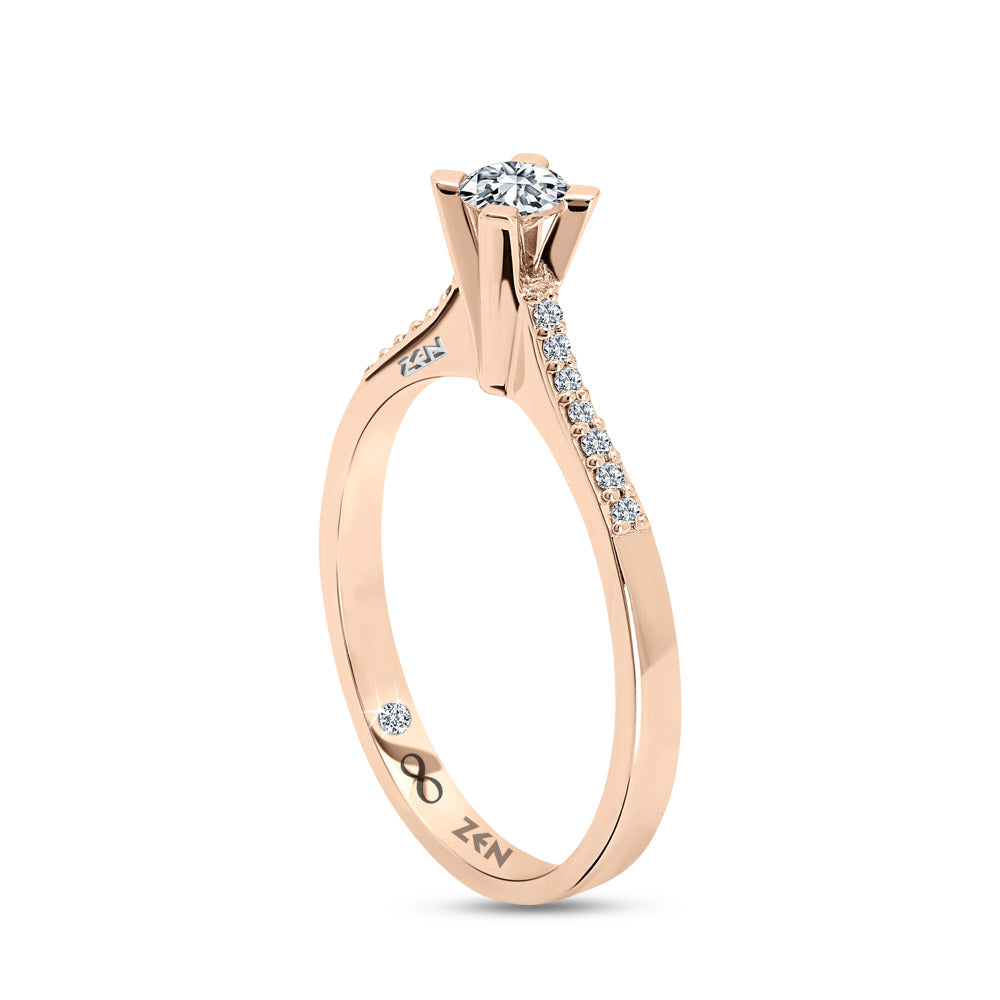
For tiny accent stones paved into a band, individual reports are less standard because the cost of grading would outweigh the value of the tiny stones. However, if a seller is reluctant to provide independent paperwork for a major center stone, that reluctance is a clear sign to look elsewhere. Choosing to explore our [engagement ring collection] guarantees that every major center stone comes fully backed by a trusted, independent grading report.
FAQs
What is a diamond certificate?
It is an independent, scientific document that details a diamond's specific physical characteristics, quality grades, and unique dimensions.
Is a diamond certificate the same as an appraisal?
No, a certificate provides a scientific analysis of quality without a price, while an appraisal assigns a dollar value for insurance purposes.
What is the difference between GIA and IGI certification?
GIA is the historic gold standard for grading natural diamonds, while IGI is the premier, most widely trusted independent lab for lab-grown diamonds.
Do lab-grown diamonds come with certificates?
Yes, a reputable lab grown diamond certificate from a lab like IGI grades the stone on the exact same 4Cs scale used for natural diamonds.
Should I buy a diamond without a certificate?
No, you should I buy a diamond without a certificate only if it consists of tiny accent stones; major center stones should always have independent paperwork to prove their quality.
What does the laser inscription on a diamond mean?
It is a microscopic number etched onto the diamond's edge that matches the grading report, proving the physical stone is the exact one described in the document.