Why Does My Oval Diamond Have a Dark Bow Tie in the Middle?
You are staring at a beautiful oval diamond, but something catches your eye. Right across the center, there is a distinct dark shadow. You might be wondering if you did something wrong, or if the stone is somehow flawed.
Take a breath. You are noticing one of the most common characteristics in elongated diamonds, and it has a name. It is called the oval diamond bow tie effect. It is completely normal, easily explained, and definitely not an automatic dealbreaker. By the end of this guide, you will know exactly what causes that shadow and how to confidently choose an oval diamond you love.
What Is the Bow Tie Effect?
The bow tie effect in diamonds is exactly what it sounds like. It is a dark, bow-tie-shaped shadow that stretches across the center width of the stone.
Crucially, this is an optical phenomenon, not a structural flaw. You will never see a "bow tie grade" listed on a GIA or IGI certificate. It simply happens because of how light travels through certain elongated shapes. While round diamonds are perfectly symmetrical and unaffected, the bow tie is incredibly common in oval, marquise, and pear cuts.
The intensity of this shadow varies wildly. It ranges from a barely perceptible contrast to a bold, dark band. That spectrum matters enormously, yet many buyer guides overlook it..
Why Does Bow Tie Happen?
Diamonds are cut to function like precision light mirrors. The facets bounce light from the pavilion—the bottom half of the diamond—back up through the crown, or top, to your eye.
In elongated shapes like ovals, the middle of the stone is narrower relative to the ends. This means fewer facets are concentrated in that central zone. If the pavilion facet angles are not perfectly optimized for that narrow space, light escapes sideways rather than returning upward. That escaping light creates the dark bow tie shadow in an oval diamond
What causes the bow tie in oval diamond cuts comes down to three main factors:
-
Facet alignment: Misaligned pavilion facets disrupt how light reflects in the center.
-
Cut proportions: A stone cut too shallow lets light leak out the bottom, while one cut too deep traps it inside. An ideal depth is usually between 58% and 62%.
-
Length-to-width ratio: Highly elongated ovals, those above a 1.50:1 ratio, are much more susceptible.
Think of the facets like a series of mirrors arranged in a circle. In a round diamond, every mirror faces inward perfectly. In an oval, the mirrors in the middle have to work harder to redirect light, and sometimes they simply miss the mark.
Is the Bow Tie Effect Bad?
The honest answer is that it depends entirely on the degree of the shadow. Is the bow tie effect bad in oval diamond cuts? Not necessarily.
A faint, barely visible bow tie is completely normal. In fact, it often adds subtle contrast and depth to the stone, making the surrounding facets look even brighter. A moderate bow tie is also perfectly acceptable to many buyers, especially if the overall cut quality and brilliance are strong.
However, a strong or severe bow tie is a genuine concern. A heavy dark band can make the center of the stone look dull, significantly reducing the diamond's overall sparkle.
Here is the key takeaway: the bow tie does not appear on grading reports. A diamond can carry an excellent cut grade and still display a prominent shadow. The question is never whether an oval has a bow tie, because most do. The real question is how visible it is, and whether you love the stone anyway.
How to Spot and Assess the Bow Tie Before You Buy
Because grading reports don’t include this detail, visual inspection is your best tool. If you want to know oval diamond bow tie how to spot, follow these practical steps:
-
View in multiple lighting conditions: Look at the stone in natural daylight, soft indoor light, and under direct spotlighting, which tends to exaggerate shadows.
-
Tilt the stone: Gently rock the diamond back and forth. A subtle bow tie will shift and blend, while a strong one will remain fixed and dark.
-
Watch 360° videos: When buying online, always request a rotating video. A static image can easily hide or minimize the severity of the shadow.
-
Ask a gemologist: Reputable retailers like Zen Diamond can assess the severity on your behalf and filter stones accordingly.
-
Compare side by side: View two or three oval diamonds together. This quickly calibrates your eye so you know what a "minimal" versus a "strong" bow tie actually looks like.
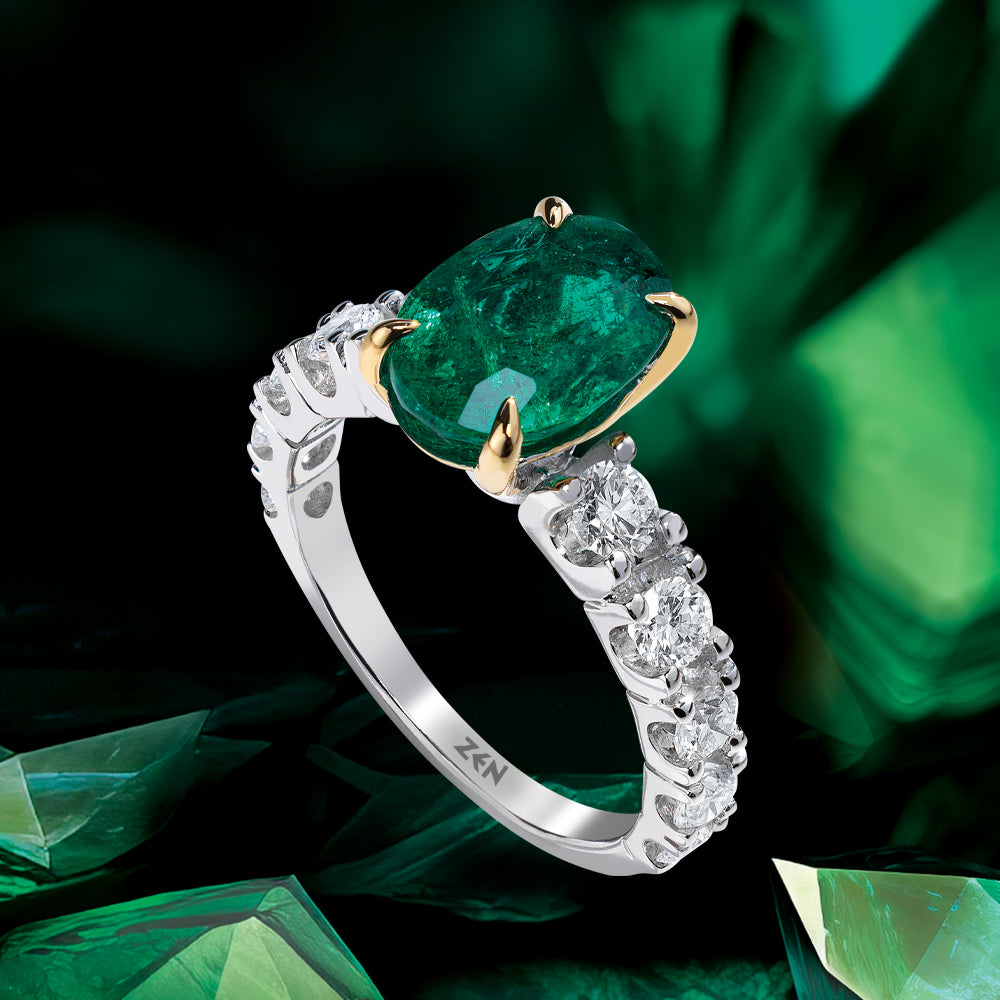
Keep in mind that the oval diamond bow tie effect will almost always look more prominent in professional photos than in person. High-contrast lighting setups used in product photography exaggerate dark spots, so do not panic based on an image alone.
How to Minimise the Bow Tie When Choosing an Oval Diamond
If you prefer a stone with minimal shadowing, the good news is that you have plenty of control. Learning how to minimize the oval diamond bow tie effect comes down to choosing the right proportions and overall cut quality. Always aim for shopping from the trusted retailers that offer perfect cut quality.
Consider your setting carefully. An oval engagement ring bow tie effect can be minimized with a halo setting, which draws the eye outward toward the perimeter sparkle. East-west settings can also beautifully reframe how the center shadow is perceived. Finally, remember that a lab grown oval diamond bow tie is just as common as one in a natural stone, because they share the exact same optical properties.