

What Is Carat Weight? How Diamond Size and Carat Are Not the Same Thing
What Is Carat Weight? How Diamond Size and Carat Are Not the Same Thing
If you've started shopping for a diamond, you've probably assumed that a higher carat number automatically means a bigger-looking stone. It's a reasonable assumption, and it's also wrong more often than most shoppers expect. Two diamonds can share the exact same carat weight and look noticeably different in size once they're set in a ring.
Quick answer: Carat weight measures how much a diamond weighs, not how big it looks. One carat equals 0.2 grams. A diamond's visible size is determined by its millimeter diameter, which depends on cut quality and shape as much as it depends on weight. A shallow, well-proportioned diamond can look larger than a deeper diamond of the same carat weight.
Here's what carat weight actually measures, why it doesn't map directly to size, and how to shop for the look you actually want.
What Carat Weight Really Measures
Carat is a unit of weight, not a unit of size. One carat equals 200 milligrams, or 0.2 grams, roughly the weight of a small paperclip. The term traces back to carob seeds, which merchants once used as a rough, consistent counterweight when trading gemstones.
That's the entire definition. Carat says nothing about a diamond's diameter, its brilliance, or how it will look on a finger. It only tells you what's on the scale.
It's also worth knowing the difference between two terms that get used interchangeably:
-
Carat weight refers to a single diamond.
-
Total carat weight (TCW) refers to the combined weight of every diamond in a piece, such as a center stone plus a halo or side stones.
A ring listed as "1.50 TCW" might have a 1.00-carat center stone surrounded by 0.50 carats of smaller accent diamonds, not one 1.50-carat stone.
Why Two Diamonds of the Same Carat Weight Can Look Different
This is the part that surprises most shoppers. A diamond's face-up size (how large it appears when viewed from above) is determined by its diameter in millimeters, not by its weight alone. Two diamonds can weigh exactly 1.00 carat and still differ by several millimeters in diameter, because of where that weight is distributed.
-
Cut depth. A diamond cut too deep carries extra weight below the girdle, hidden from view. It can weigh a full carat while looking closer to a 0.90-carat stone from above.
-
Cut proportions. A well-proportioned cut spreads the weight outward instead of downward, maximizing the visible diameter for a given weight.
-
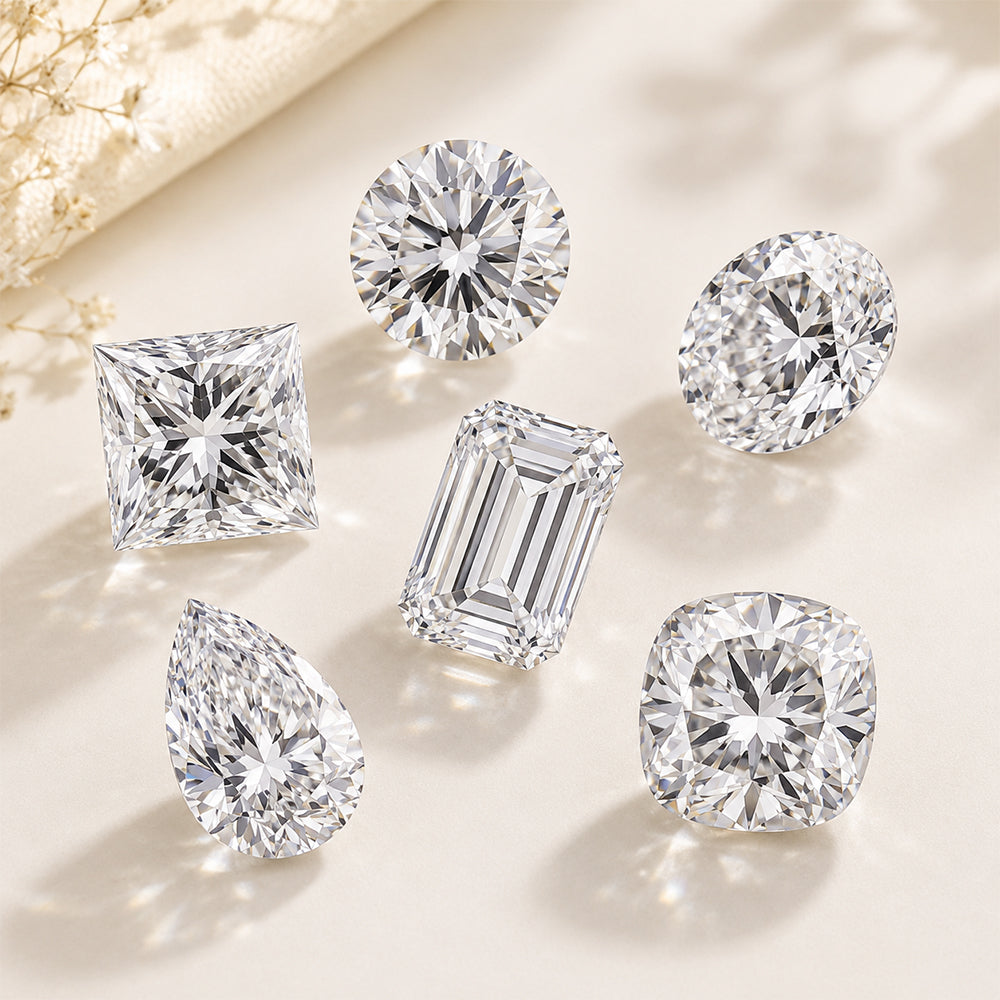
Shape. Elongated shapes such as oval, marquise, and pear stretch across more surface area than compact shapes like round or princess cuts. An oval and a round diamond at the same carat weight will rarely look the same size, with the oval typically appearing larger.
Jewelers sum these factors up with a simple rule: cut affects apparent size more than carat weight does.
Round Diamond Carat to Size Chart
For a well-cut brilliant round diamond, here's roughly what carat weight translates to in millimeter diameter:
|
Carat Weight |
Approx. Diameter |
|
0.50 ct |
5.1–5.2 mm |
|
0.75 ct |
5.8 mm |
|
1.00 ct |
6.4–6.5 mm |
|
1.50 ct |
7.4 mm |
|
2.00 ct |
8.1–8.2 mm |
Notice that the jump from 1.00 to 2.00 carats is only about 1.7 mm in diameter, even though the weight doubles. That's because a diamond's weight scales with its volume, while its visible size scales with surface area. Doubling the carat weight doesn't come close to doubling how big the stone looks.
This is also why a poorly cut 1.00-carat diamond can measure closer to 6.1 mm, noticeably smaller than a well-cut one at 6.5 mm, despite an identical certificate weight.
Why This Matters for Your Budget
Diamond prices don't rise in a straight line with carat weight. Price increases sharply at whole and half-carat marks (0.50, 0.75, 1.00, 1.50, 2.00), because demand clusters around those round numbers. A diamond weighing 0.98 carats can cost meaningfully less than one weighing 1.02 carats, while looking essentially identical on the hand.
This gap is where informed shoppers save money. A diamond just under a popular weight threshold, with excellent cut proportions, often delivers the same visual size as the "full" carat weight next to it, at a lower price.
How to Shop by Size, Not Just by Carat
If looking larger matters more to you than hitting a specific carat number, a few adjustments make a real difference:
-
Prioritize cut grade. An Excellent or Ideal cut grade generally keeps depth percentage low enough that the diamond faces up at or near its expected diameter.
-
Consider elongated shapes. Oval, pear, marquise, and emerald cuts tend to appear larger per carat than round or cushion cuts.
-
Check the millimeter measurements, not just the carat weight. Every diamond listing should include length, width, and depth in millimeters. Compare those numbers directly instead of relying on the carat figure alone.
-
Look at the setting. A halo setting, a thin pavé band, or a bezel can all make a center stone read as larger than its raw measurements suggest.
Frequently Asked Questions
Does a higher carat weight always mean a bigger diamond?
No. Carat weight measures mass, not visible size. Cut quality and shape both influence how large a diamond actually looks, so a lower-carat, well-cut diamond can appear larger than a higher-carat diamond with poor proportions.
What is the difference between carat and total carat weight (TCW)?
Carat weight refers to a single stone. Total carat weight adds up every diamond in a piece of jewelry, including a center stone and any accent stones, so a "1.50 TCW" ring is not necessarily a single 1.50-carat diamond.
Why do diamond prices jump so much at 1.00 carat?
Round-number carat weights carry disproportionate demand and rarity value. A diamond at 0.98 carats can look identical to one at 1.02 carats while costing noticeably less, simply because it falls just under the psychological one-carat threshold.
Which diamond shapes look larger for their carat weight?
Elongated shapes, including oval, marquise, and pear cuts, generally appear larger than round or princess cuts at the same carat weight, because their shape spreads more surface area across the finger.